


Kyushu University EU Centre: JMCoE-Q3 Kick-off Seminar “e-Governance and e-Democracy in the European Union”
On 24 April 2025, the Jean Monnet CoE Kyushu, Third Stage (JMCoE-Q3) Kick-off Seminar titled “e-Governance and e-Democracy in the EU” was conducted by the Kyushu University EU Centre and supported by the Delegation of the European Union to Japan and the Fukuoka EU Association. It was held in a hybrid format at KU, in Japanese and English with consecutive interpretation, and also as an online event open to the general public. This kick-off seminar was organized to commemorate the start of the JMCoE-Q3 project, to strengthen cooperation with EU-related and international organizations for the future development of the project, and to promote understanding of the aims, objectives, and significance of the project and the EU to the wider public.
The opening was addressed in-person by Prof. Kenji Iwata, Executive Vice President of KU and former Director of the KU EU Centre, and online by Mr Peter Fatelnig, Minister-Counsellor for Digital Economy Policy, Delegation of the European Union to Japan, in Tokyo. This was followed by an address by Prof. Jiro Hasumi, Director of the KU EU Centre, and then the headline lecture “e-Governance and e-Democracy in the European Union” by Prof. David Ramiro Troitiño of Tallinn University of Technology in Estonia, who came to Japan under the Erasmus+ Mobility Agreement with KU EU Centre. In Estonia, where almost all administrative procedures are completed online, he discussed how further deepening from e-governance to e-democracy is underway in the EU, as well as issues related to AI and EU public policy. During the Q&A session, questions from the audience were answered, and discussions were deepened on EU public policy and other topics. The session concluded with closing remarks by Prof. Machiko Hachiya, Advisor to KU EU Centre. The seminar, which was conducted in a hybrid format, resulted in a successful kick-off with approximately 50 participants from all over Japan taking part.
The KU EU Centre first strengthened its expertise on EU matters while acting as the consortium leader of the EU Institute in Japan, Kyushu (EUIJ-Kyushu, 2011-2016), which was funded by the European Commission, during which it actively promoted EU-related education and research. In recognition of these achievements, the next round of funding was granted under the Jean Monnet CoE within the framework of Erasmus+, the funding programme for research and education of the EU, for a total of seven years in the first stage (2016-2019) and second stage (2020-2024). With contributions from academic and other stakeholders both in Japan and abroad, they continue to carry out fruitful research, education, and outreach activities related to the EU and Europe at large.
While building on the achievements of previous activities, the Jean Monnet CoE Kyushu, Third Stage (JMCoE-Q3, Dec. 2024-Nov. 2027) aims to expand the substance of its research and education and contribute to the international community, further deepening its activities by establishing two core themes: “The EU and Environmental Issues” and “The EU and Civil Society”. This will link KU's long-standing accumulation of research and education on the EU and Europe with the urgent issues facing Europe and the world, which the EU has defined as priorities under Erasmus+, with the aim of creating a major international hub for EU research and education in Japan and East Asia as the only Jean Monnet CoE in Japan.
Source: Kyushu University EU Centre
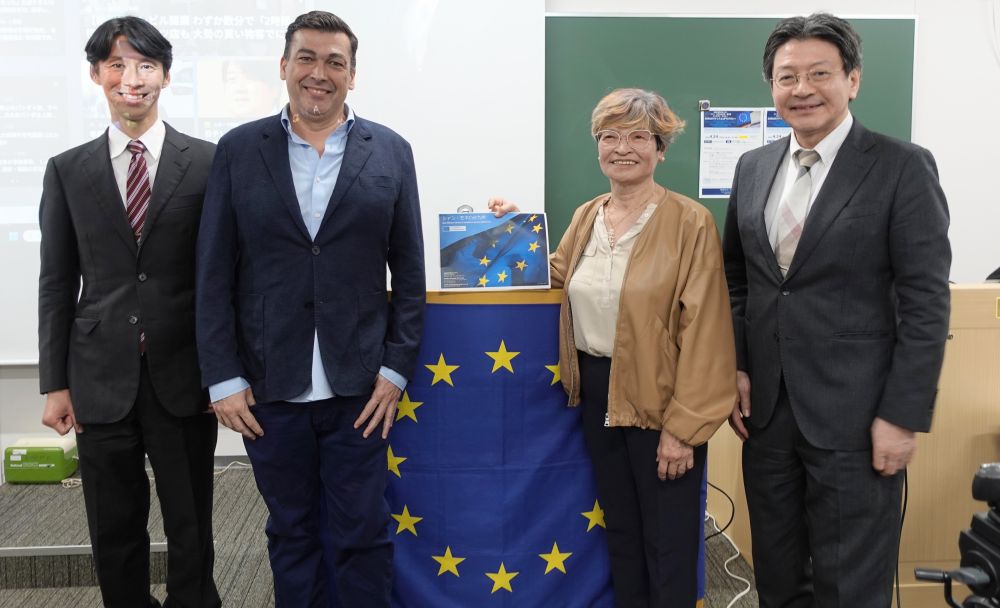
Photo from left to right, Prof. Jiro Hasumi, Prof. David Troitiño, Prof. Machiko Hachiya, Prof. Kenji Iwata
Published: June 2025