Details for mission participants
The Digital Business Mission in Japan 2026, organised by the EU-Japan Centre for Industrial Cooperation, is centered around the CEATEC 2026 trade fair taking place 13-16 October 2026 in Makuhari Messe in Chiba prefecture (near Tokyo). The Centre's booth is the EU Pavilion (booth location TBC)
1. Schedule
|
Date |
Event |
Details |
|
Oct. 12 |
Recommended arrival and check-in at your hotel in Tokyo / Chiba city |
To be booked by participants themselves |
|
Oct. 13 |
09:30 Hotel lobby (to receive exhibition badge holder for exhibitor) 10:00 Exhibition start (Joint EU-Japan Centre booth) 11:00-12:30 Business Event (organised by the EU-Japan Centre for EU companies) (TBC) 17:00 Travel to Palace Hotel (takes about 1 hour) 18:30-20:00 CEATEC Opening Reception (one invitation per company, invitations distributed on 13 October at booth) |
Location Exhibition: Makuhari Messe (google maps)
Location Reception: Palace Hotel Tokyo (google maps) |
|
Oct. 14 |
10:00 Exhibition start (Joint EU-Japan Centre booth) 15:30-16:30 Pitch event 1 at CEATEC (organised by EU-Japan Centre at Pitch Stage) 18:00-19:00 Exhibitor Networking Event for CEATEC exhibitors |
Location Exhibition: Makuhari Messe (google maps) |
| Oct. 15 |
10:00 Exhibition start (Joint EU-Japan Centre booth) 10:30-12:15 Tours of Japanese companies visiting the EU-Japan Centre booth (TBC) 12:15-13:15 Event at CEATEC (organised by EU-Japan Centre at X Stage) 15:00-16:00 Pitch event 2 at CEATEC (organised by EU-Japan Centre at Pitch Stage) 16:00-17:00 Networking hour at booth |
Location Exhibition: Makuhari Messe (google maps) |
|
Oct. 16 |
10:00 Exhibition start (Joint EU-Japan Centre booth) 16:45 Wrap-up session |
Location Exhibition: Makuhari Messe (google maps) |
2. Cost
The EU-Japan Centre covers all expenses related to exhibition booth fees, event fees, poster translation/printing,interpretation services, and accommodation from the night before the first mission day until the morning of the last mission day.
Flight costs and miscellaneous expenses related to your stay, such as meals and local transportation, are not covered by the Centre.
Note: The EU Japan Centre covers expenses for 1 participant that has been selected for the mission. Colleagues from the same company travel at their own cost. If, for any reason, the person, that represents the company on the mission, has to change, please contact us as early as possible.
3. Travel Planning
3.1. Border Entry Regulations for Japan
Visiting Japan without a visa is possible in case of visa-exempted nationalities*. In case you have questions concerning the border entry regulations, please contact the Embassy of Japan in your country.
*Please check the visa agreements of your nationality with your local Japanese Embassy.
3.2. Flight
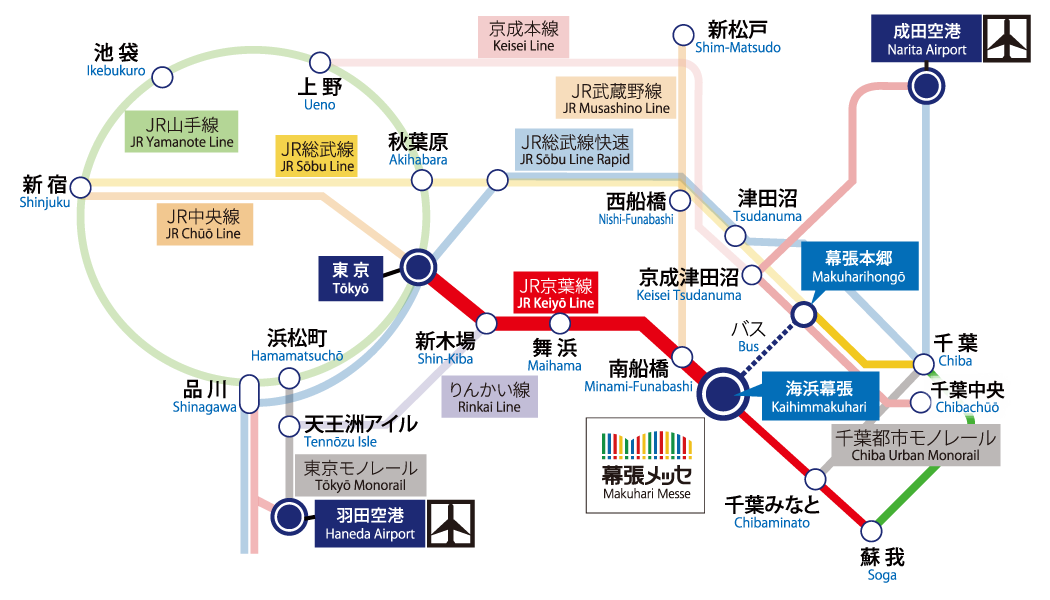
The Digital Mission will take place in area of Chiba city and the greater Tokyo area. It is recommended to arrive at one of the two international airports in Tokyo area. Narita International Airport (NRT) and Haneda (HND) are recommended. Travel time to the exhibition venue is comparable from either airport. Due to the long distance from the airports, we also recommend not to take a taxi from the airport, but to use other public transport instead.
Please note that travel times to Japan are longer than before due to the ongoing conflict in Ukraine and the resulting restrictions on Russian airspace.
(Source: Makuhari Messe Inc.)
3.3. Hotel
The EU-Japan Centre will provide selected participants with accomodation close to or in reasonable travel distance to the event venues from the night before the first mission day until the morning of the last mission day.
- Accommodation arranged by the EU-Japan Centre is provided only for the selected mission participant (one participant per organisation). It does not cover accompanying colleagues.
- All accommodation arrangements will be handled by the travel agency contracted by the EU-Japan Centre.
- You will be contacted with more by email around August, providing accommodation details, including the hotel name and access information.
- Participants' names, email addresses and any other information necessary for the reservation will be shared with the travel agency.
- If participants have additional requests (e.g. early check-in, late check-out or additional nights), the travel agency will explain how such requests can be made when they first contact the participants.
- If participants wish to book accommodation for accompanying colleagues, the travel agency may be able to assist under its own conditions. However, this does not guarantee a room in the same hotel, as availability will depend on the hotel's occupancy.
- If a participant cancels their participation in the mission and cancellation charges apply, the amount will be deducted from the mission deposit.
4. Networking and receptions
Participants are invited to several networking sessions and receptions during the Business Mission.
13 October – All participants (max. 1 per company) are invited to the Opening Reception from the CEATEC exhibition organisers from 18:30-20:30 at Palace Hotel Tokyo.
14 October – All participants are invited to CEATEC networking receptions for exhibitors from 18:00-19:00, at the Makuhari Messe.
15 October – Networking hour at the EU Pavillion at CEATEC
5. Information for your space in the Centre’s joint booth at CEATEC 2026
5.1. Company space
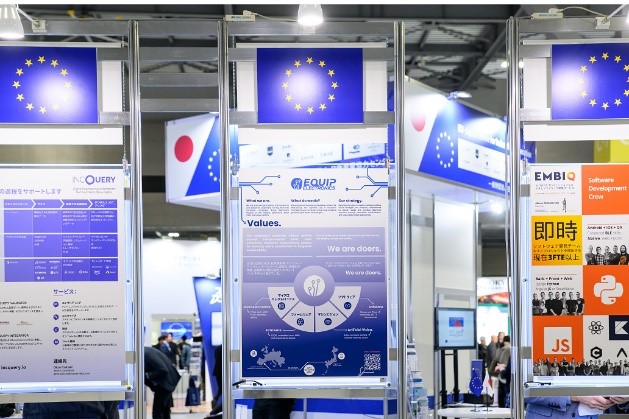
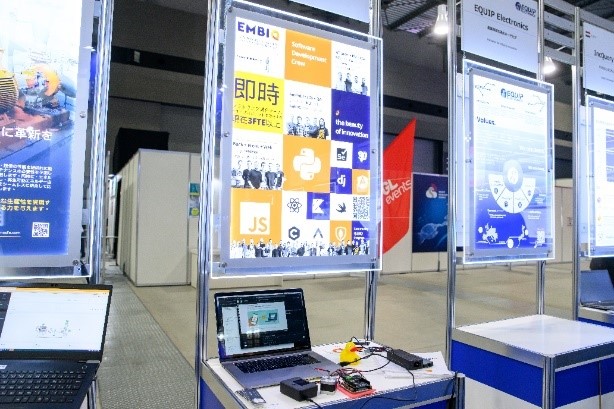
The EU-Japan Centre has reserved a 108 sqm shared booth at CEATEC 2026, where all participating companies will have their own space consisting of:
1) A company name board
2) A Poster in A1 size
3) A small display space to place brochures, business cards etc.
4) A simple (non-locked) sliding door cabinet to place personal items.
5) A box for client’s business cards
In addition, there will be a small joint space with a few tables and chairs, a water server with cold and hot water, tea, and instant coffee. Centre staff at the joint booth can take care of inquiries about your company should you be absent from the stand. Three interpreters will be in the EU-Japan Centre booth. You can request their services in case you face serious language barriers at the venue.
5.2. Company description / 40 character description
This short description will be listed on your company/cluster name board which is going to be placed above your poster.
5.3. Company introduction
Your company introduction may be longer, with a maximum of 100 words. This introduction will be used to introduce you as a participant of the Business Mission to the EEN Japan network and exhibition visitors.
5.4. Poster
Your poster could highlight your company’s brand, products and services or recent research findings.
All posters shall be vertically arranged and will be printed in A1 size.
We offer you to translate your poster from English to Japanese with costs borne by the EU-Japan Centre. The number of words in the poster should not exceed 200.
For the poster to be translated into Japanese, there are two options:
1) If you already have a Poster in Illustrator or other professional graphic design formats:
You send us an image of an existing English poster and a text file with the text it contains. After the translation of the text by the Centre, we return the Japanese text to you and you (or your graphic designer) place the Japanese text in the original poster file.
You convert the file to PDF in A1 format and send it back to us for printing in Japan.
2) If you do not use professional graphic design software
You submit your poster to us as a ppt or pptx file in A1 format (You can download a template here or set the size yourself under Design >> Slide Size >> Custom Slide Size >> W594mm x H841mm). The Centre will translate and edit the text in the data and send a PDF back to you for confirmation. After you have checked the contents we will print the file in Japan.
In either case, please make sure that you send us a document where the translators can directly work in (word, ppt, etc). We will always ask for your final confirmation after the translation.
5.5. Company logo data (high quality data for large prints)
On the Fascia board of the Centre’s joint booth, we include the logos of all organisations participating in the Mission
6. Practical Information
6.1. Dress Code
The standard in Japanese business, especially for official meetings with clients, are dark-coloured suits such as navy, charcoal gray, or black for men. The suit usually goes along with a a light-coloured dress shirt and a tie. For women, neutral tones' skirt suits or pant suits are the norm. Skirts usually cover the knees, and blouses do not show cleavage.
At trade fairs or more casual business occasions, the style can be more relaxed but jeans or flashy colours or patterns are usually avoided. While in many Japanese companies, fitting in with the group is common, western visitors will usually be permitted more liberty in style.
6.2. Business Cards
Business cards are are still prevalent in Japanese business culture. Prepare to bring many of them with you as you will need one for every person you'll meet in a business conversation even at the Expo stand. Business cards are treated with great respect. They should not be pocketed right away or written on in the presence of your counterpart.
6.3. Electricity and Power Plugs
The voltage used throughout Japan is 100 volts, and there are two kinds of frequencies in use. Japan uses US-type 2-flat-pin plugs.
We recommend buying an adapter before your departure. The frequency in Eastern Japan (including Tokyo, Yokohama, Tohoku, and Hokkaido) is 50 Hz, and the one in Western Japan (including Nagoya, Kyoto, Osaka, Shikoku, and Kyushu) is 60 Hz. This frequency difference affects only sensitive equipment.
6.4. How to move around
Public Transport Planner Apps
Google Maps works decently to search for transport connections.
Japan Travel by Navitime Japan provides some more details and has an app for iOS and Android
The Jorudan Japan Transit Planner is another service with an English page and apps for iOS and Android.
Transportation from and to Airports
Airports in Japan are usually well connected by public transport.
The Keikyu and JR lines provide access to Makuhari Messe through Tokyo Station from Haneda (HND) airport while the Narita Express and other JR lines offers access from Narita (NRT) airport. Both airports can also be reached by Limousine Busses to Kaihin Makuhari station.
Transportation Payment Cards
Several IC cards that can be used as prepaid transportation tickets and E-Money are available in Japan.
Physical cards for tourists can be obtained at Narita and Haneda airport. Look out for Welcome Suica and Pasmo Passport.
All IC cards work on most public transport systems nationwide.
There are also App versions of these cards, which can be installed if your location is set to Japan (Settings > General > Language & Region)
One of the best explanations in English about the app exists for PASMO for iOS (ApplePay)
Taxis and other ride services
Due to regulation, Uber operates in Japan using taxi businesses. Rideshare is only in a test phase.
GO and S.Ride are the most common taxi Apps.
nearMe.Airport is a hybrid between a taxi and a bus. This service is available for airports such as Narita and Haneda in Tokyo.