In September 2026, the EU-Japan Centre for Industrial Cooperation launched a new monthly…


Qualification for public works (Keishin)
Bidding for government contracts for the construction and design of public works requires a different qualification system. It includes the Business Matters Evaluation (keiei jikō shinsa), popularly known as keishin. The system gives Japanese government entities assurance that a supplier can fulfil its contract, which matters most for large-scale construction projects.
Insiders regard the process as routine public-sector business, but it can be cumbersome for foreign companies that only occasionally take on public works contracts.
Bidders must apply separately to each government entity where they wish to bid. As a result, the public works construction market tends to be divided: large general contractors win large-scale projects across the country, while smaller construction and design companies win small, local projects.
The keishin is stipulated by the Construction Business Act (Article 27-23). It must be taken every year and involves a substantial amount of paperwork and external costs. It is also only the first step towards the final supplier qualification, because the keishin result (a numerical score) is required to complete the qualification application.
Schematic overview of the Business Evaluation and supplier qualification process
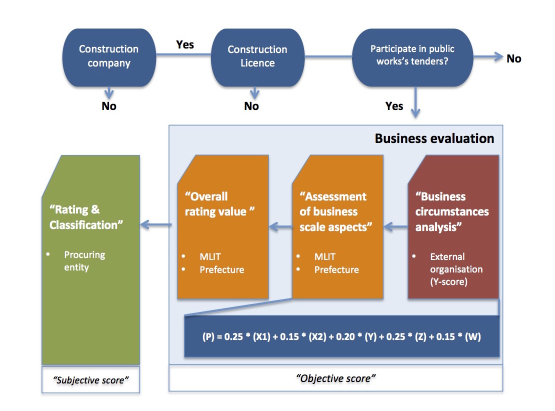
Source: MLIT Kanto Regional Development Bureau (J)
The keishin itself is carried out by a limited number of third-party organisations and companies designated by the Ministry of Land, Infrastructure, Transport and Tourism (MLIT). They charge a fee of EUR 100 to EUR 250 for a three-day express service. The keishin standards are unified nationwide.
MLIT-designated administrative agencies performing Business Evaluations
|
Company/organisation name |
Location |
Telephone number |
|
|
Tokyo |
+81-3-6661-7427 |
N.A. |
|
|
Kumamoto |
+81-96-278-8330 |
||
|
Nagano |
+81-26-232-1145 |
||
|
Nagasaki |
+81-95-811-1477 |
N.A. |
|
|
Sapporo |
+81-11-820-6111 |
||
|
Utsunomiya |
+81-28-649-0111 |
||
|
Tokyo |
+81-3-6685-1008 |
||
|
Ube |
+81-836-38-3781 |
||
|
Kita-Kyushu |
+81-93-982-3800 |
||
|
Construction Industry Management Information Analysis Center Inc. (CIAC.JP) |
Tokyo |
+81-42-505-7533 |
Form |
Source: MLIT, http://www.mlit.go.jp/totikensangyo/const/1_6_bt_000091.html (List as of January 2025)
The agencies do not provide information on the keishin in English. The Helpdesk can assist you with the procedures for obtaining the Business Evaluation Notification.
Period of validity of the Business Evaluation: the “standard screening day”
Business circumstances change from day to day, so most items in the Business Evaluation are assessed as of a single fixed date, the “standard screening day”. This is the last day of the most recently completed business year, i.e. the day before accounts are settled.
The Business Evaluation is valid for one year and seven months from the standard screening day. In practice, this means it has to be renewed annually.
Schematic overview of the Business Evaluation and qualification process
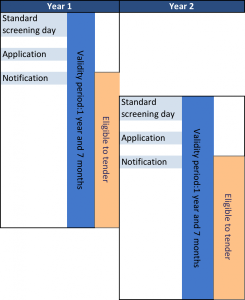
Please note that if you apply for the following year’s Business Evaluation too late, there will be a gap in your eligibility to participate in public works tendering.
Source: MLIT Kanto Regional Development Bureau, Business Evaluation and Supplier Qualification Guidelines (in Japanese)
Supplier Qualification Screening
The Supplier Qualification Screening is conducted by MLIT or by the government organisation where you are applying to participate in a tender. It combines the score generated by the keishin (the “Objective Score”) with the organisation’s own evaluation score (the “Subjective Score”) to produce a total score, which is then used to rate and classify your company. A list of contact points for this screening is available.
The cost of the screening depends on the number of construction activities you apply for. It can reach EUR 600 if you apply for registration in 14 categories.
Keishin scoring
The keishin is based on a complex formula that generates a numerical score, the Comprehensive Evaluation Value (P), for each activity a company wishes to engage in. The formula quantifies and weights various aspects of the company’s performance.
|
Keishin Business performance calculation |
|
|
(P) = 0.25x (X1) + 0.15x(X2) + 0.20x(Y) + 0.25 x (Z) + 0.15 x (W) |
|
|
X1 |
Turnover gained from completed works by type of work |
|
X2 |
Capital and average profit |
|
Y* |
Y expresses the business situation generated from 8 indicators including Ordinary profit ratio, Return on assets, Capital ratio, Business cash flow (absolute) and Accumulated earnings (absolute) Each of these indicators also has its own weight and is put into a formula. |
|
Z |
In-house registered accountants, engineers and specialists, turnover of completed prime contractor work |
|
W |
Other items such as employee welfare, number of years in business, presence/absence of application for corporate rehabilitation, contributions to disaster prevention, law-abidingness, construction accounting situation, R&D, Machinery, ISO |
Source: Nyusatsu Research Centre


EU-Japan Centre for Industrial Cooperation
Joint venture established in 1987 by the European Commission (DG GROW) and the Japanese Government (METI) for promoting all forms of industrial, trade and investment cooperation between the EU and Japan.


Copyright © 2026 EU-Japan Centre