(Last Update: 2 Nov. 2026)
Details for mission participants
The Nanotech Business Mission in Japan 2026, organised by the EU-Japan Centre for Industrial Cooperation, is centred around the 26th nano tech trade fair taking place 16-18 December 2026 in Tokyo Big Sight in Tokyo, Japan. The EU-Japan Centre's booth location is 3S-U09, in South Hall 3.
1. Schedule
|
Date |
Event |
Details |
|
14 Dec. 2026 (Monday) |
|
|
|
15 Dec. 2026 (Tuesday) |
|
|
|
16 Dec. 2026 (Wednesday) |
|
|
| 17 Dec. 2026 (Thursday) |
|
|
|
18 Dec. 2026 (Friday) |
|
|
2. Cost
The EU-Japan Centre covers all expenses related to exhibition booth fees, event fees, poster translation/printing, interpretation services, and accommodation from the night before the first mission day until the morning of the last mission day.
Flight costs and miscellaneous expenses related to your stay, such as meals and local transportation, are not covered by the Centre.
Note: the EU Japan Centre covers expenses for 1 participant that has been selected for the mission. Colleagues from the same company travel at their own cost. If, for any reason, the person, that represents the company on the mission, has to change, please contact us as early as possible.
3. Travel Planning
3.1. Border Entry Regulations for Japan
Visiting Japan without a visa is possible in case of visa-exempted nationalities*. In case you have questions concerning the border entry regulations, please contact the Embassy of Japan in your country.
*Please check the visa agreements of your nationality with your local Japanese Embassy.
3.2. Flight
The Nanotech Mission will take place in the area of Odaiba, Tokyo. It is recommended to arrive at one of the two international airports in Tokyo area. Narita International Airport (NRT) and Haneda (HND) are recommended. Travel time to the exhibition venue is comparable from either airport. Due to the long distance from the airports, we also recommend not to take a taxi from the airport, but to use other public transport instead.
Please note that travel times to Japan are longer than before due to the ongoing conflict in Ukraine and the resulting restrictions on Russian airspace.
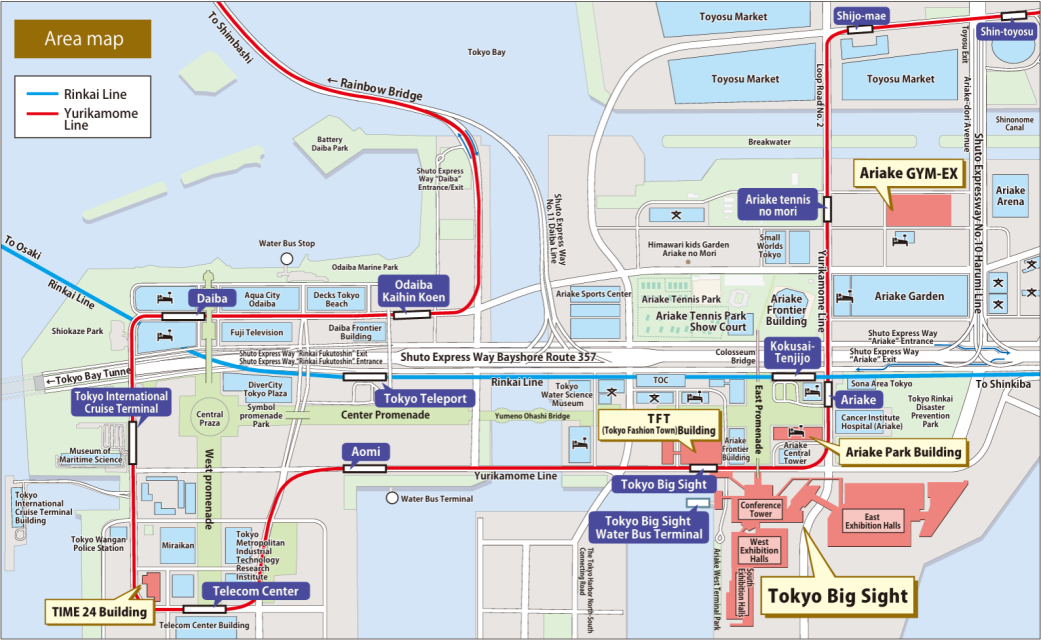
(Source: © Tokyo Big Sight Inc.)
3.3. Hotel
The EU-Japan Centre will provide selected participants with accommodation close to or in reasonable travel distance to the event venues from the night before the first mission day until the morning of the last mission day.
- Accommodation arranged by the EU-Japan Centre is provided only for the selected mission participant (one participant per organisation). It does not cover accompanying colleagues.
- All accommodation arrangements will be handled by the travel agency contracted by the EU-Japan Centre.
- You will be contacted with more details by email (soon), providing accommodation details, including the hotel name and access information.
- Participants' names, email addresses and any other information necessary for the reservation will be shared with the travel agency.
- If participants have additional requests (e.g. early check-in, late check-out or additional nights), the travel agency will explain how such requests can be made when they first contact the participants.
- If participants wish to book accommodation for accompanying colleagues, the travel agency may be able to assist under its own conditions. However, this does not guarantee a room in the same hotel, as availability will depend on the hotel's occupancy.
- If a participant cancels their participation in the mission and cancellation charges apply, the amount will be deducted from the mission deposit.
4. Pre-Event
On Tuesday, 15 December 2026, participants are invited to a side-event.
This full-day event will include (TBC):
- Visit to NIMS
- Potential additional side-event (TBC)
5. Information for your space in the Centre’s joint booth at nano tech exhibition
5.1. Company space
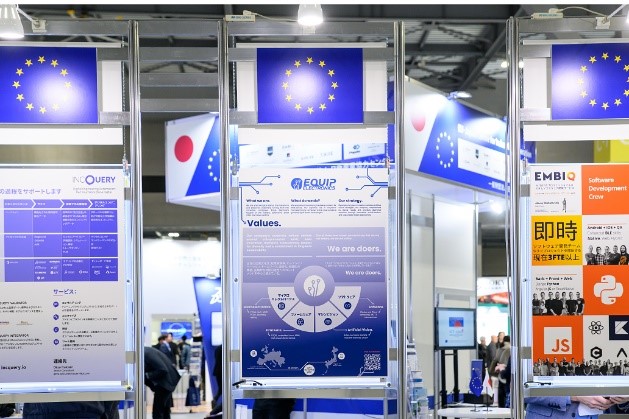
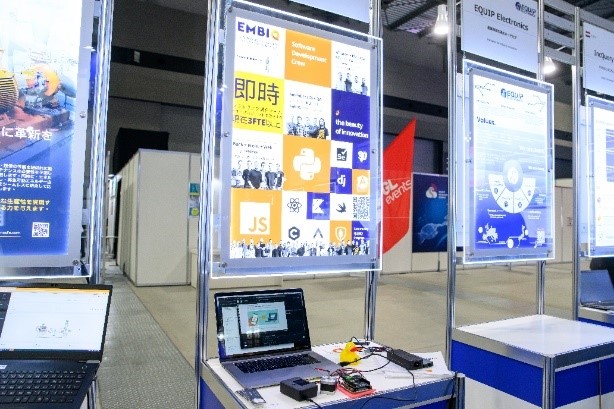
The EU-Japan Centre has reserved a 72 sqm shared booth at the nano tech exhibition, where all participating companies will have their own space consisting of:
1) A company name board
2) A Poster in A1 size
3) A small display space to place brochures, business cards etc.
4) A simple (non-lockable) sliding-door cabinet to place personal items.
In addition, there will be a small joint space with a few tables and chairs, a water server with cold and hot water, tea, and instant coffee. Centre staff at the joint booth can take care of inquiries about your company should you be absent from the stand. Three interpreters will be in the EU-Japan Centre booth. You can request their services in case you face serious language barriers at the venue.
5.2. Company description / 40 character description
This slogan or short description will be listed on your company/cluster name board which is going to be placed above your poster.
5.3. Company introduction
Your company introduction may be longer, with a maximum of 60 words. This introduction will be used to introduce you as a participant of the Business Mission to the EEN Japan network and exhibition visitors.
5.4. Poster
Your poster should highlight your company’s brand, products and services or research findings.
All posters shall be vertically oriented and printed in A1 size.
The EU-Japan Centre will cover the cost of translation from English to Japanese, up to 200 words.
Option 1 – You use professional design software (e.g. Illustrator):
- Send us the English poster image (e.g. PDF) and a text file with the English text.
- We will translate the text and return the Japanese version for insertion into your design.
- After finalising the layout, please provide us with a final PDF in A1 format for printing in Japan.
Option 2 – You use PowerPoint:
- Prepare your poster in PowerPoint (A1 size: W594 mm × H841 mm).
- You can download a template here or set the size under Design → Slide Size → Custom Slide Size.
- The Centre will insert the Japanese translation and send you a PDF for final approval before printing.
In both cases, please send editable files (Word, PowerPoint, etc.) so that translators can work directly in them.
We will always request your confirmation before printing.
5.5. Company logo data (high quality data for large prints)
High-resolution logos will be displayed on the fascia board of the EU-Japan Centre joint booth.
Disclaimer: Please note that the booth design and participants' display space are not confirmed yet and may be subject to change.
6. Practical Information
6.1. Dress Code
The standard in Japanese business, especially for official meetings with clients, are dark-coloured suits such as navy, charcoal gray, or black for men. The suit usually goes along with a a light-coloured dress shirt and a tie. For women, neutral tones' skirt suits or pant suits are the norm. Skirts usually cover the knees, and blouses do not show cleavage.
At trade fairs or more casual business occasions, the style can be more relaxed but jeans or flashy colours or patterns are usually avoided. While in many Japanese companies, fitting in with the group is common, western visitors will usually be permitted more liberty in style.
6.2. Business Cards
Business cards are still prevalent in Japanese business culture. Prepare to bring many of them with you as you will need one for every person you'll meet in a business conversation even at the Expo stand. Business cards are treated with great respect. They should not be pocketed right away or written on in the presence of your counterpart.
6.3. Electricity and Power Plugs
Japan uses 100 volts, with two frequencies:
- 50 Hz in Eastern Japan (Tokyo, Yokohama, Tohoku, Hokkaido)
- 60 Hz in Western Japan (Nagoya, Kyoto, Osaka, Kyushu)
Plugs are US-type, two flat pins.
Please bring a suitable adapter.
The frequency difference only affects certain sensitive devices.
6.4. How to move around
Public Transport Planner Apps
Google Maps works decently to search for transport connections.
Japan Travel by Navitime Japan provides some more details and has an app for iOS and Android.
The Jorudan Japan Transit Planner is another service with an English page and apps for iOS and Android.
Transportation from and to Airports
Airports in Japan are usually well connected by public transport.
- By Limousine Bus (recommended option)
Both airports can also be reached by Limousine Busses to Tokyo Big Sight (25 min. from Haneda Airport; 80 min. from Narita Airport). The tickets for Limousine Busses can be purchased online or upon your arrival on ticket vending machines at each airport.
-
From Haneda Airport (HND)

Reservation is below [Airport Limousine website] -
From Narita Airport (NRT)

Reservation is below [Airport Limousine website]
-
- By Train
Airports are also well connected by trains.
- By train, from Haneda Airport (HND) to Tokyo Big Sight area:
- Option 1: take the Tokyo Monorail and change at Tennozu Isle station. Then, take the Rinkai Line to Kokusai-tenjijo station.
- or Option 2: take the Keikyu Line (direct connection via the Toei Asakusa Line; no transfers required for this section on direct trains) and change at Shimbashi station. Then, take the Yurikamome Line to Tokyo Big Sight station.
- By train, from Narita Airport (NRT) to Tokyo Big Sight area:
- Step 1: Narita Airport to Tokyo or Shinagawa Station
- Board the Narita Express (N'EX) from Narita Airport Terminal 1 or Terminal 2·3.
- Ride to Tokyo Station (takes about 53–60 minutes) or Shinagawa Station.
All seats are reserved, costing approximately ¥3,070 for a standard ticket.- Option via Tokyo Station: Transfer to the JR Keihin-Tohoku or Yamanote Line to Shimbashi Station (about 4 minutes), then switch to the Yurikamome Line to Tokyo Big Sight Station (about 22 minutes). Total local fare is around ¥600–¥700.
- Option via Shinagawa Station: Transfer to the JR Yokosuka Line or Yamanote Line to Shimbashi Station, then take the Yurikamome Line to Tokyo Big Sight Station.
- Step 2: Transfer to Local Lines
- Option via Tokyo Station: Transfer to the JR Keihin-Tohoku or Yamanote Line to Shimbashi Station (about 4 minutes), then switch to the Yurikamome Line to Tokyo Big Sight Station (about 22 minutes). Total local fare is around ¥600–¥700.
- Option via Shinagawa Station: Transfer to the JR Yokosuka Line or Yamanote Line to Shimbashi Station, then take the Yurikamome Line to Tokyo Big Sight Station.
- Step 3: Arrival
- Alight at Tokyo Big Sight Station, which is a 3-minute walk from the venue.
- Step 1: Narita Airport to Tokyo or Shinagawa Station
- By train, from Haneda Airport (HND) to Tokyo Big Sight area:
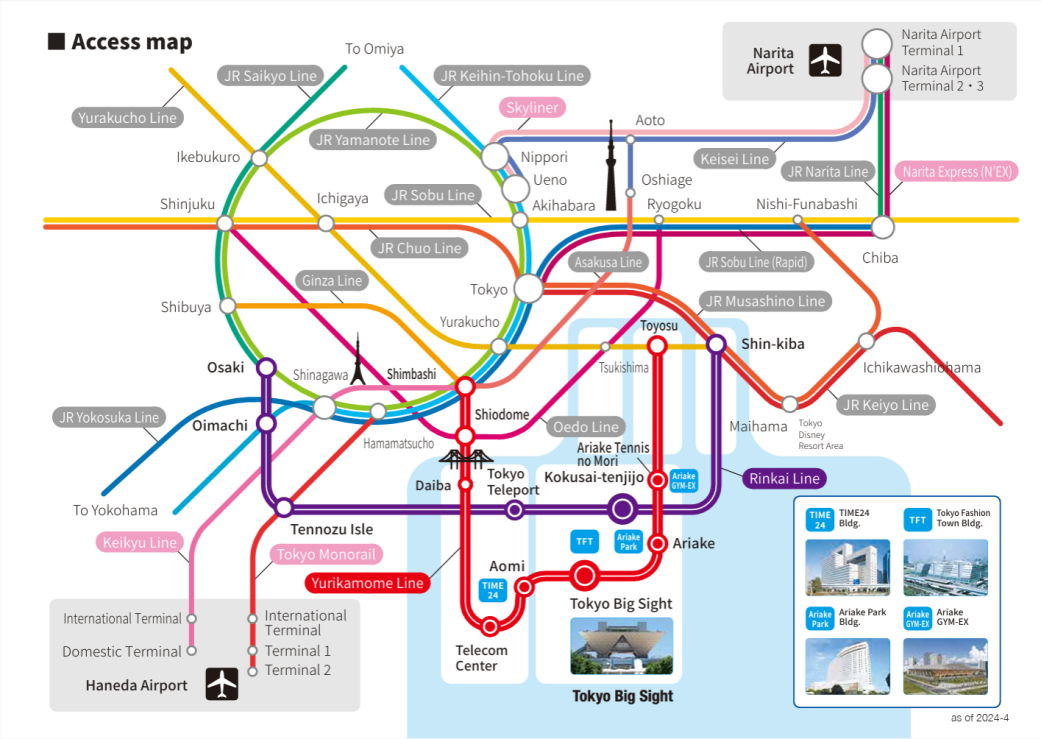
(Source: © Tokyo Big Sight Inc.)
Transportation Payment Cards
Several IC cards that can be used as prepaid transportation tickets and E-Money are available in Japan.
Physical cards for tourists can be obtained at Narita and Haneda airport. Look out for Welcome Suica and Pasmo Passport.
All IC cards work on most public transport systems nationwide.
There are also app. versions of these cards, which can be installed if your location is set to Japan (Settings > General > Language & Region).
One of the best explanations in English about the app exists for PASMO for iOS (ApplePay)
Taxis and other ride services
Due to regulation, Uber operates in Japan using taxi businesses. Rideshare is only in a test phase.
GO and S.Ride are the most common taxi apps.
nearMe.Airport is a hybrid between a taxi and a bus. This service is available for airports such as Narita and Haneda in Tokyo.