In September 2026, the EU-Japan Centre for Industrial Cooperation launched a new monthly…
Tender monitoring & informations

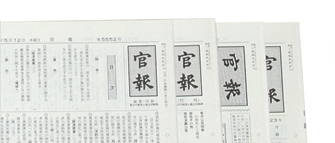
Early announcement of tenders is one of the voluntary measures taken by the Japanese government to facilitate access for foreign companies in the Japanese public procurement market. As early as possible at the beginning of the fiscal year, in the April-May period procurement of large-scale goods and services are publics in the “Kanpo” Government Gazette. Early announcement of tenders is largely limited to national government entities and affiliated organizations.
Kankouju or ‘Public Agency Orders’ relates to the budget of public procurement spending reserved specifically for SMEs. This earmarked budget is regulated by the Act on Ensuring Receipt of Orders from the Government and Other Public Agencies by Small and Medium-sized Enterprises established in 1966.
In fact, more than half of the tenders are reserved for SMEs. The Japanese government sets a target for each year, in FY 2013. 56% of the total expected demand of €61.7 billion was reserved for SMEs.
Japan does not have a one singular web portal in English for publishing all tender notices by the government. There are several procurement portals, each with their own scope and functionalities. While the procurement information is in principle publicly available for free, there are some company that gather the information from the thousands of government sites and offer this data as a paid service.
Please note the following with regard to the English information provided:
Governments require a vast array of goods and services to perform their duties, which makes it difficult to assess Japan’s government procurement market as a whole. Foreign suppliers are currently primarily active in the following sectors (value-based), but still hold relatively small shares:
Only a few comprehensive statistics are available on public procurement in Japan to obtain a good overview of how and where Japanese government institutions spend their money. Although various statistics can be found, they are difficult to compare, as different thresholds are often applied when compiling them. On this page you will find a selection of statistical resources regarding public procurement in Japan.
The framework of laws, ordinances and regulations governing government procurement in Japan is one of high complexity, involving dozens of legal texts. Procurement by national entities is subject to the Public Accounting Law. Public procurement by local government is governed by the Local Autonomy Law (J). This has resulted in the development of two separate legal structures for government procurement.
Japan signed up to the World Trade Organisation Agreement on Government Procurement (GPA) in 1994, in order to create better opportunities for foreign companies in the signatories’ respective countries. Concretely, this means that countries that joined the GPA take measures to ensure fair and equal treatment of suppliers, irrespective of whether they are a domestically based company or based in one of the other signatories’ countries.
| Type of procedure | Occurrence | Tender size |
|---|---|---|
| Open Tendering | Common | Any |
| Selective Tendering | Rare | Any |
| Limited (Single) Tendering | Frequent | Any |
| Open Counter | Frequent | Small |
| Reverse (Dutch) Auction |
The Japanese public procurement market holds huge potential, with EU estimates ranging from €550 billion to €565 billion. EU companies remain relatively underrepresented in this market, partly owing to non-regulatory barriers, geographical distance, and limited market knowledge. EU companies currently active in the sector tend to be larger global players with an established presence in Japan.
QuestionWe are in Japan for business activities, companies that are providing us with services charge us Consumption Tax. Can we get a refund of the Consumption Tax paid in Japan? |
AnswerYou can only receive a return of Consumption Tax paid in Japan, if you have taxable sales within Japan with in a base period. |


Joint venture established in 1987 by the European Commission (DG GROW) and the Japanese Government (METI) for promoting all forms of industrial, trade and investment cooperation between the EU and Japan.