Related
Tender documentation

Given the large diversity in the goods and services that are procured by government entities, it rather difficult to give a concise description of the contents of tender documentation. For the procurement of relatively simple items, the documentation can be short, but for complex items, the tender documentation can consist of hundreds of pages of text. 

Explanatory briefings

In case of the procurement of complex goods or services, the procuring entity will organize an explanatory meeting, usually within days after the invitation to tender.  Please note that the information whether an explanatory meeting will be organized, is usually not listed in the English summary of the tender notice. 

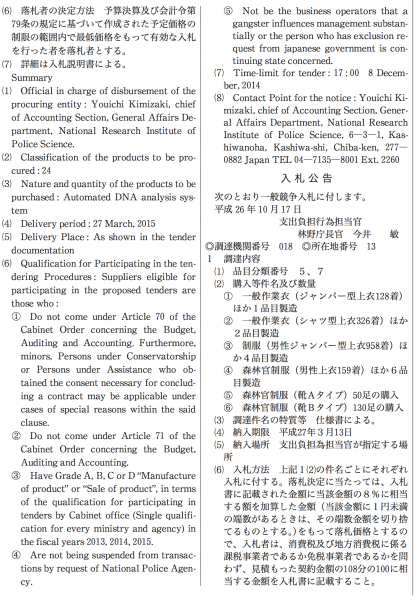
The tender notice explained

For foreign suppliers with no Japanese language capabilities, the English language summary of the tender notice is the first source of information to decide whether there is a business case to tender for a contract.  Below explains in more detail what kind of information is provided, and perhaps more important, the information that is not provided in the English summary.

English summary explanation

Procurement info mailing lists

A number of national government organisations have established mailing list services to announce their calls for tender.  The mailing lists are almost exclusively in Japanese. Listed below are links to registration pages for procurement information mailinglists at a number of government organisations. 

Tender monitoring & informations

Early announcement of tenders

Early announcement of tenders is one of the voluntary measures taken by the Japanese government to facilitate access for foreign companies in the Japanese public procurement market.  As early as possible at the beginning of the fiscal year, in the April-May period procurement of large-scale goods and services are publics in the “Kanpo” Government Gazette.  Early announcement of tenders is largely limited to national government entities and affiliated organizations. 

Kankouju: ‘Public Agency Orders’ Tenders reserved for SMEs

Kankouju or ‘Public Agency Orders’ relates to the budget of public procurement spending reserved specifically for SMEs.  This earmarked budget is regulated by the Act on Ensuring Receipt of Orders from the Government and Other Public Agencies by Small and Medium-sized Enterprises established in 1966.  

In fact, more than half of the tenders are reserved for SMEs. The Japanese government sets a target for each year, in FY 2013. 56% of the total expected demand of €61.7 billion was reserved for SMEs.

Tender notice portals


English language portals

Japanese language portals

Japan External Trade Organization (JETRO)

Read more - Direct link

Government Procurement Information Website

Current market

Governments require a vast array of goods and services to perform their duties, which makes it difficult to give a specific indication for specific products. Foreign companies are currently primarily active in the following sectors (value-based), but still have relatively small shares:

Statistics

Only a few comprehensive statistics are available on public procurement in Japan to obtain a good overview of how and where Japanese government institutions spend their money. Although various statistics can be found, they are difficult to compare, as different thresholds are often applied when compiling them. On this page you will find a selection of statistical resources regarding public procurement in Japan.

Legal framework

The framework of laws, ordinances and regulations governing government procurement in Japan is one of high complexity, involving dozens of legal texts. Procurement by national entities is subject to the Public Accounting Law. Public procurement by local government is governed by the Local Autonomy Law (J). This has resulted in the development of two separate legal structures for government procurement.

WTO

Japan signed up to the World Trade Organisation Agreement on Government Procurement (GPA) in 1994, in order to create better opportunities for foreign companies in the signatories’ respective countries. Concretely, this means that countries that joined the GPA take measures to ensure fair and equal treatment of suppliers, irrespective of whether they are a domestically based company or based in one of the other signatories’ countries.

EU-Japan Centre's News

More
The Centre quarterly newsletter, June 2026 issue, is now available. In this issue:   Last chance…
The Belgian-Luxembourg Chamber of Commerce in Japan (BLCCJ) is organizing the 13th edition of the…
The EU Japan Centre is releasing a weekly press review covering Japan's economic and business…

Events

More
Japan
16/03/2026 - 19/03/2026
  The next mission will take place from 23-26 March, 2027 Planned application period: September - early November 2026   Please note that this page is still under construction; content relating to…
Japan
05/10/2026 - 09/10/2026
Mission dates: 05 - 09 Oct 2026 Are you active in the biotech, pharma, or related healthcare sectors and seeking business, technology, or collaboration opportunities in Japan? This autumn, the EU-…
Time in Brussels
-
Time in Tokyo
-
Exchange rate
1€ = 185,370 JPY