
Library

The EU-Japan EPA grants professionals from EU countries access to Japan beyond what is secured by GATS. Access for short term business visitors (STBV) is outlined in the treaty for those employed by firms doing business in the host country. There are no quotas for STBV.STBV are tied to EU-based employers.

Access for business visitors for investment purposes (BVIP) is outlined in the treaty for those employed by firms doing business in Japan and the European Union. No quotas for business visitors from the European Union entering Japan for investment purposes. Professionals of the EU covered by 8-B Annex III are generally tied to EU-based employers.

The EU-Japan EPA grants access to professionals beyond what is secured by GATS. There are no quotas for business visitors for establishment purposes, intra-corporate transferees or investors from the European Union entering Japan. Professionals of the EU covered by 8-B Annex III are generally tied to EU-based employers.

The authors of this report developed a series of tools and techniques for perfecting ways of navigating virtual communication and interaction with Japanese partners. At any stage in a business relationship and whatever the precise business format both European and Japanese companies will benefit from those insights into Japanese strategic and tactical thinking.

The aim of this report is to present an overview of trends and opportunities on the Japanese jewellery market, drawn from the experiences of European companies, and to deliver strategic insight, tactical guidance and real-life examples of how to succeed in the Japanese jewellery market.

Japan spends consistently over 3% of its GDP on R&D, of which some 70% come from industry. Concerning biotech-related R&D, more than half is directed towards pharmaceutical and medical goals, but agricultural, industrial and environmental biotech are recently getting more attention in view of a future “bioeconomy” based on “smart cells” and a better integration of biological and digital innovations.

Japan society has been late in digitisation, but the government tries to speed this up, among other things, to reduce the cost of health care. This is an excellent opportunity for EU companies with exciting solutions.

Three French companies – hydrogen taxi company Hype, industrial gas supplier Air Liquide, and energy supplier Idex – joined forces with Japanese car manufacturer Toyota Motor in 2019 to form HysetCo, a joint-venture determined to bring a change to the mobility landscape. Together, they deploy in Paris the world’s largest fleet of hydrogen taxis.
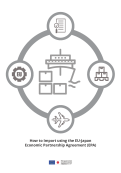
Would you like to start importing food or non-food stuffs from Japan, but are unsure what 'preferential tariff treatment', 'rules of origin' and 'HS codes' are? "How to Import using the EU-Japan Economic Partnership Agreement (EPA)" is a handbook for the EPA, can help you find your way and also point you to sources of help and information. The handbook includes straightforward explanations, step-by-step instructions, 3 case studies and other tips.

JAPANESE INDUSTRY AND POLICY NEWS April, 2021
Legislation and Policy News
METI and UAE cooperate in hydrogen field, signed MOU on building green hydrogen supply chain
Ocean release of treated water from nuclear power plants, two years after
Japan's greenhouse gas reduction target raised to "46% reduction in 2030"
Add up to JP¥ 600,000 to Tokyo's "Zero Emission Vehicle" subsidy
Start of operation of "heat stroke warning alert" announced with a heat index of 33 or higher


EU-Japan Centre for Industrial Cooperation
Joint venture established in 1987 by the European Commission (DG GROW) and the Japanese Government (METI) for promoting all forms of industrial, trade and investment cooperation between the EU and Japan.


Copyright © 2026 EU-Japan Centre